Why When I Get a Bsod It Doesnt Start Back Yp Again
How to Set up a Windows Blue Screen of Decease (BSOD)
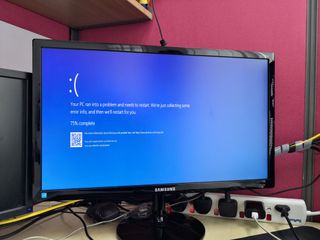
Few things are more frustrating. You're in the middle of working on a project, reaching a major milestone in a game or maybe just booting up your Windows ten computer and, merely like that, the entire Bone crashes and presents you with a Blue Screen of Decease, usually for no immediately credible reason.
In Windows-speak, the term "Blueish Screen of Death" is usually abbreviated as BSOD. It describes an fault of some kind that hits the operating system difficult enough that it's forced to quit. Microsoft itself labels such errors with "stopcodes." Thus these errors may also be generically named "finish errors." Hither'due south an example that shows what a BSOD sometimes looks like:
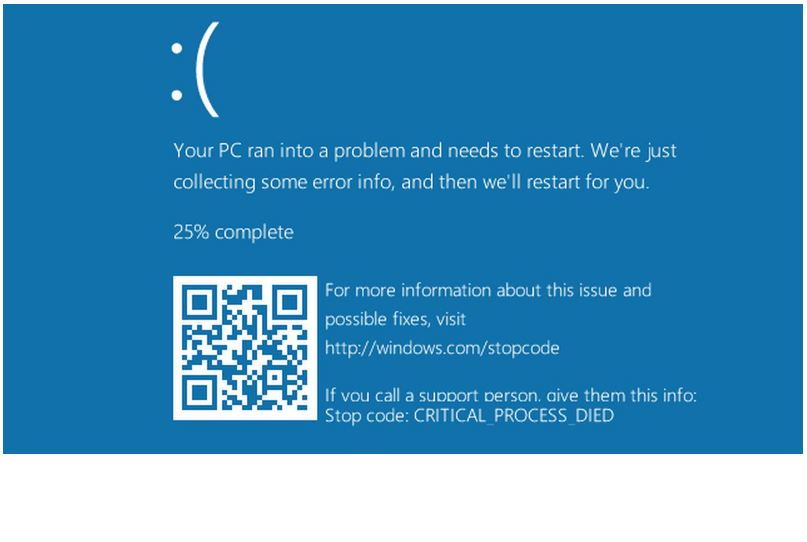
Understanding the BSOD Screen
The screen starts with an sometime-fashioned unhappy face up emoticon " :( " (a colon, followed by an open up parenthesis). Next, you see a brief explanation that "Your PC ran into a problem and needs to restart." Windows writes one or more log files when a stop error occurs, then you see language about "collecting some mistake info" and a counter that keeps runway while it'south writing that data (shows equally "25% complete) in a higher place.
Microsoft provides a scannable QR code in mod BSODs (lower left) that you can scan with a smartphone and look upwardly that mode. The message also provides a lookup URL for stopcodes, where you can enter a numeric stopcode (and where you'll encounter most common stopcodes, including the one shown above). The most common stop codes include:
- CRITICAL_PROCESS_DIED
- SYSTEM_THREAD_EXCEPTION_NOT_HANDLED
- IRQL_NOT_LESS_OR_EQUAL
- VIDEO_TDR_TIMEOUT_DETECTED
- PAGE_FAULT_IN_NONPAGED_AREA
- SYSTEM_SERVICE_EXCEPTION
- DPC_WATCHDOG_VIOLATION
Yous tin too download the Microsoft Fault Lookup Tool (current version: Err_6.four.5.exe) to look upwardly numeric fault codes at a command prompt or in PowerShell, if you adopt.
In Windows ten, BSODs Aren't E'er Blue
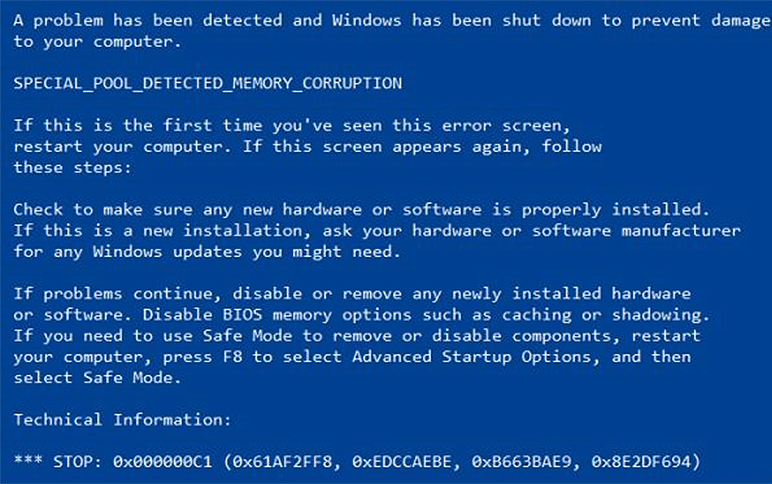
Before Windows 8 came along in October 2012, BSODs ever appeared on dark blue screens. These were chock-full of text and instructions (see below). With Windows 8, Microsoft switched to a kinder, gentler format shown in the preceding screencap. They also whittled downward the information that appears on screen. In fact, the groundwork color in Windows ten is sometimes light-green, which is why y'all may come across some of them called GSODs ("Green Screens of Death"). Here's an instance of an old-fashioned, pre-Windows-8 BSOD to put this information into historical context:
Making Sense of BSOD Data
Though nobody wants to come across a BSOD on a Windows PC, they do occur from time to time. In the vast majority of cases, the PC will restart itself automatically afterward an fault log, called a crash dump or a dump file (extension .dmp) is created. By default, Windows 10 stores dump files in one of ii locations.
Y'all can manage crash dumps through Advanced System Settings in Windows 10 (blazon "Advanced Organisation Settings" into the search box, then click "Settings" in the Startup and Recovery pane). You can also choose to toggle "Automatic restart" to off here, if you would adopt that any hereafter BSODs stay on the screen until you get a risk to see them and write down (or accept pic of) any relevant data.
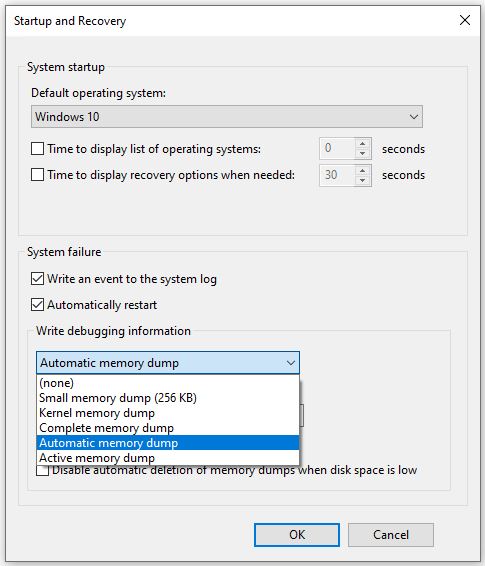
If you select "Small retentivity dump" as the option for saving crash dumps, such files prove upward equally Minidump.dmp files. For all other selections, the crash dump is named Memory.dmp. Crash dumps get written to the %SystemRoot% folder, which usually expands to C:\Windows. Past design, small-scale memory dump files are limited to 256KB in size. Other memory dumps will vary in size up to the size of memory on the PC where the dump is collected. Thus, on a PC with 16 GB of RAM, a Complete memory dump file will ever be sixteen GB in size (and other dump files, except for the small memory dumps, can be equally big equally 16 GB, but will often be smaller).
Examining a crash dump file can be helpful when troubleshooting related causes. For more than details, meet our story on how to use a minidump file to fix your Windows BSOD. That said, many users simply search on the stopcode and/or the numeric error code when seeking remediation communication. (Notation that Microsoft calls that numeric lawmaking a "bug bank check code" or "problems bank check string."
What To Practice When Troubleshooting a BSOD
The firsthand trend following a BSOD is to get right into fix-it mode, offset looking things up, and attempting repairs. Not and then fast! Microsoft explains the entire troubleshooting process in its "Troubleshoot blueish screen errors" tutorial. While you lot can – and probably should – read the Microsoft advice in its entirety, here'south a summary of key recommendations:
- Shut down the Windows PC that experienced the BSOD
- Disconnect all USB-attached devices except for mouse and keyboard (or wireless dongles).
- Reboot your system into rubber mode from the Windows Recovery Environment (WinRE)
- If you recently installed new software, uninstall that software.
- If yous recently installed a new device driver (or your BSOD info points to a commuter or device), uninstall or roll back that commuter (if you don't really need the device you tin can disable it temporarily instead)
- Restart the PC, and see if the BSOD recurs. If not, you've probably isolated the cause and tin can start researching some kind of prepare.
If the BSOD recurs despite the items taken out of the picture by removing, disabling or uninstalling them, whatever's still left in the picture remains problematic. At this point you want to reboot into prophylactic mode once once more, and open up an administrative command prompt or PowerShell session. From the command line, enter these commands, one at a time:
- DISM /Online /Cleanup-image /Restorehealth
- SFC /scannow
The first of these ii commands finds and replaces whatsoever damaged operating organisation components in the side-past-side filestore (aka WinSxS). The second of these commands runs the Arrangement File Checker (SFC) and volition repair any damaged files it finds.
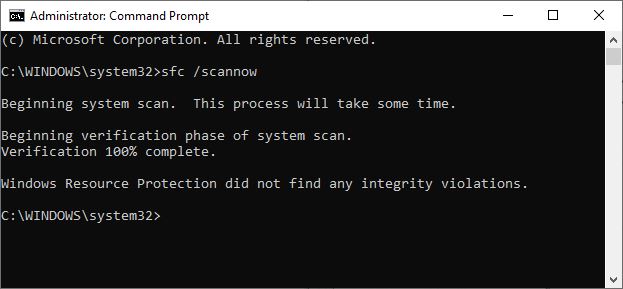
Note that if SFC finds and fixes anything, you lot should run the command until it comes back with a clean pecker of health (in some cases, I've had to run it 2 or iii times before it came dorsum clean). Note further that running either or both of these commands tin take some time to complete, especially if one or both find items in need of fixing. Hither's what y'all want to come across subsequently your terminal SFC run:
There's a consummate BSOD handling infrastructure bachelor from Microsoft, built effectually a tool called the Windows Debugger (aka WinDBG). You tin can download it as part of Microsoft's free Windows Programmer Kit if you really want to dig into the gory details. There are a lot of details to learn about, and minutiae to accost, if you want to put this tool to work on crash dumps. For non-It professionals or non-developers, I recommend Nir Sofer's excellent BlueScreenView utility instead. Information technology'southward set up to automatically load the symbol tables it needs to resolve error codes, and it knows where to notice crash dumps in need of assay. Information technology also presents crash dump data in a highly-readable form.
As an illustration, I forced one of my test laptops (a Lenovo ThinkPad X390 Yoga) to blue screen at an administrative command line. There, I entered the cord taskkill /im svchost.exe /f. Warning: typing this string into an administrative command prompt or PowerShell session volition crash the PC immediately. That's because it kills a key programme named svchost.exe (Service Host) that supports DLLs in the Windows runtime environment. Considering most (if not all) Windows programs utilize one or more than DLLs this basically makes Windows inoperable. Thus, it causes an immediate BSOD with the CRITICAL_PROCESS_DIED stopcode (shown in the lead-in graphic for this very story).
When I fired upward BlueScreenView on that PC, information technology found the Memory.dmp file that this BSOD created during its mail service-crash cleanup stage. Here's what the application looks like:
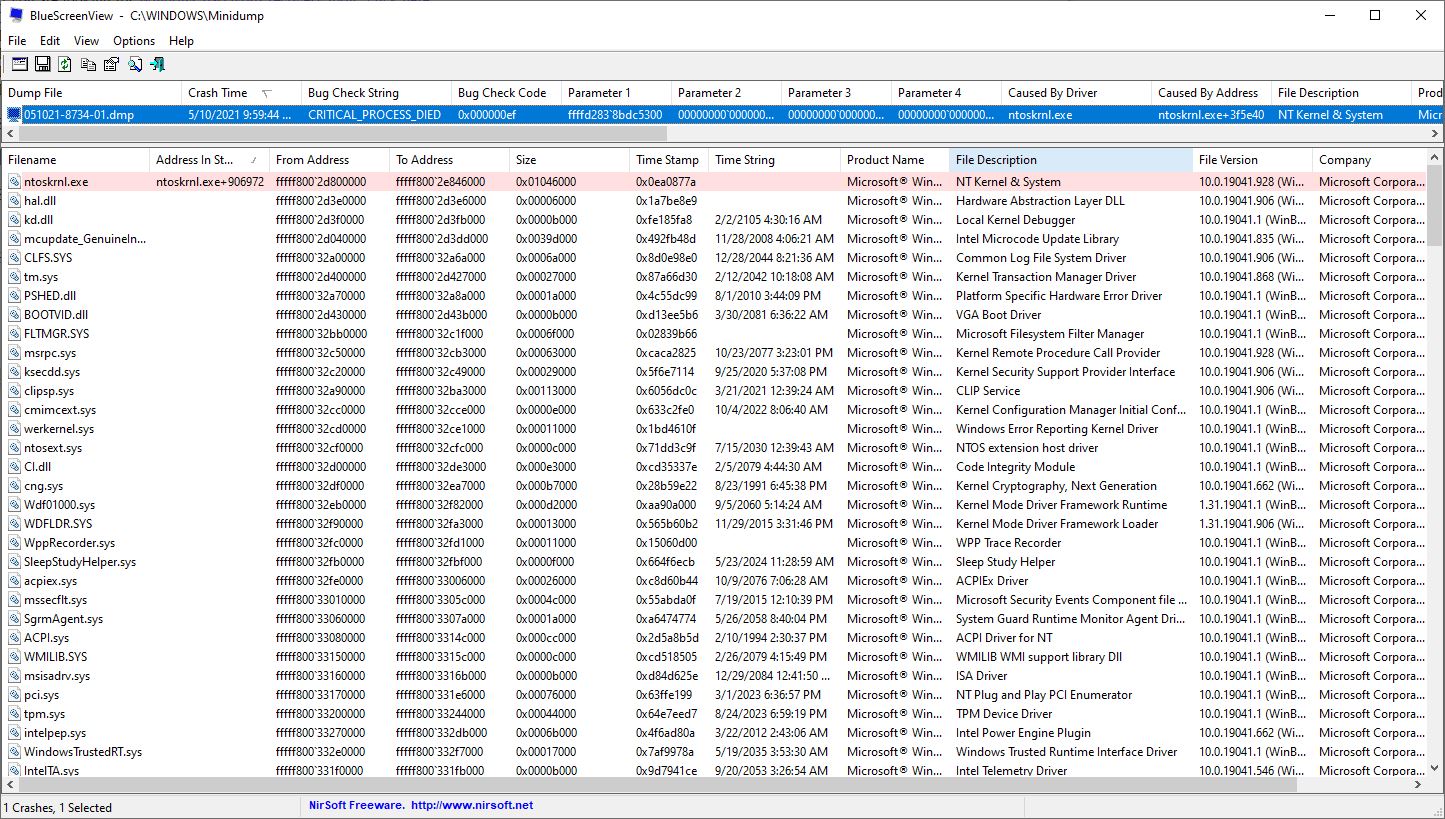
The top pane of the window shows all the crash dumps information technology finds on the target PC. Because there'south only one in this case, I shrunk information technology down to bear witness as many details from the bottom pane as possible. Yet, the data in the height pane is of import, with information in sure columns of special interest. Column 1 shows the name of the dump file. Column three shows the stopcode, which it labels "Problems Cheque String." Column iii shows the associated hexadecimal error code, 0x000000ef, which it labels "Bug Cheque Code."
For most genuine BSODs (remember, I forced this 1 to happen) the stopcode and the fault code will often assist afflicted users zilch in on causes and potential cures for their woes. In my experience, at least 90% of BSODs become fixable simply based on this data. That'southward considering it will often be solved by disconnecting, disabling, or uninstalling related devices, drivers, applications, or updates – just every bit Microsoft recommends, and I summarized in the previous section.
What About that Other Problematic 10% of BSODs?
Some BSODs won't be amenable to quick and easy fixes. When they come upward, as they sometimes will, it'due south time to ask for help in getting things figured out. I can recommend 2 terrific sources of troubleshooting help available online, each with its own dedicated user forum specifically focused on solving BSOD issues. Likewise, each one stipulates sure requirements on users seeking BSOD assistance.
Source number one comes from TenForums.com (key disclosures: I am a VIP member of this customs; I contribute input and suggestions to its members daily). The TenForums venue is in its BSOD Crashes and Debugging forum. Posting instructions are explicitly provided, along with a collection of BSOD tutorials, including those on WinDBG Basics,and how to Install and Configure WinDBG for BSOD Assay, Run BSOD Error Troubleshooter in Windows 10, and Enable or Disable BSOD Automatic Restart in Windows 10.
Source number two comes from British PC security and troubleshooting site BleepingComputer.com. They operate a user forum named Windows Crashes and Blue Screen of Death (BSOD) Assist and Support. There, you'll discover pinned threads for the following topics (all of which are worth reading through):
- Sysnative Blue Screen of Death (BSOD) Academy: A serial of detailed questions readers should answer to inquire the experts at Sysnative for help with BSOD bug.
- BSOD Posting instructions: what information users should assemble (based on downloading and running a Sysnative app) to obtain necessary dump files and content.
- BSODs simply no Dump Files: instructions on how to configure a Windows PC to produce dump files whenever a BSOD occurs. Essential to know because diagnosis without dumps is nearly incommunicable.
Thus, you'll have to read up a bit, download some tools, run some scripts and/or collect some logs that you'll submit to make a semi-formal request for BSOD help. This will take i or more hours and forcefulness you to do some homework before such aid becomes available. It may also involve numerous back-and-forth communications, where you're asked to run additional diagnostic tools and collect additional logs and data to shed more than light on your state of affairs. Trust me: these guys know what they're doing. I've seen only a handful of bug where users did everything asked of them where the BSOD experts couldn't help them get things stock-still.
Ultimately, where there'south enough will to go a Windows BSOD fixed, at that place's a way to make that happen. Keep at it, and you'll larn this for yourself.
hendersonshat1988.blogspot.com
Source: https://www.tomshardware.com/how-to/fix-windows-bsod

Post a Comment for "Why When I Get a Bsod It Doesnt Start Back Yp Again"