What Style of Art Was Oil Painting in the 1500s
| Raphael | |
|---|---|
 Presumed portrait of Raphael[1] | |
| Born | Raffaello Santi (or Sanzio) March 28 or Apr 6, 1483 Urbino, Duchy of Urbino |
| Died | April 6, 1520 (aged 37) Rome, Papal States |
| Resting place | The Pantheon, Rome |
| Known for |
|
| Notable work |
|
| Movement | High Renaissance |
| Parent(s) |
|
Raffaello Sanzio da Urbino [a] (Italian: [raffaˈɛllo ˈsantsjo da urˈbiːno]; March 28 or April 6, 1483 – April 6, 1520),[2] [b] known mononymously as Raphael,[c] was an Italian painter and architect of the High Renaissance. His work is admired for its clarity of class, ease of composition, and visual achievement of the Neoplatonic ideal of human grandeur.[4] Together with Michelangelo and Leonardo da Vinci, he forms the traditional trinity of dandy masters of that period.[5]
Raphael was enormously productive, running an unusually big workshop and, despite his early death at 37, leaving a big trunk of work. His career falls naturally into three phases and 3 styles, first described by Giorgio Vasari: his early on years in Umbria, and then a flow of about four years (1504–1508) absorbing the artistic traditions of Florence, followed by his last hectic and triumphant twelve years in Rome, working for 2 popes and their close assembly.[6] Many of his works are found in the Vatican Palace, where the frescoed Raphael Rooms were the central, and the largest, work of his career. The best known work is The School of Athens in the Vatican Stanza della Segnatura. After his early years in Rome, much of his piece of work was executed by his workshop from his drawings, with considerable loss of quality. He was extremely influential in his lifetime, though exterior Rome his work was more often than not known from his collaborative printmaking.

After his death, the influence of his great rival Michelangelo was more widespread until the 18th and 19th centuries, when Raphael'south more than serene and harmonious qualities were again regarded as the highest models. Cheers to the influence of fine art historian Johann Joachim Winckelmann his work became a formative influence on Neoclassical painting, but his techniques would later be explicitly and emphatically rejected by groups such equally the Pre-Raphaelite Brotherhood.
His father was court painter to the ruler of the pocket-sized but highly cultured city of Urbino. He died when Raphael was eleven, and Raphael seems to have played a part in managing the family workshop from this bespeak. He trained in the workshop of Perugino, and was described as a fully trained "chief" by 1500. He worked in or for several cities in n Italian republic until in 1508 he moved to Rome at the invitation of the pope, to work on the Vatican Palace. He was given a series of of import commissions in that location and elsewhere in the city, and began to piece of work every bit an builder. He was still at the acme of his powers at his death in 1520.
Background
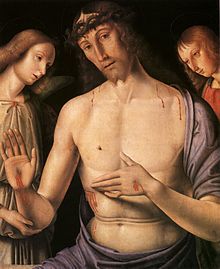
Giovanni Santi, Raphael'due south father; Christ supported by two angels, c.1490
Raphael was born in the small-scale but artistically significant central Italian city of Urbino in the Marche region,[7] where his father Giovanni Santi was court painter to the Duke. The reputation of the court had been established by Federico da Montefeltro, a highly successful condottiere who had been created Duke of Urbino past Pope Sixtus IV – Urbino formed part of the Papal States – and who died the year before Raphael was born. The emphasis of Federico's court was more literary than artistic, but Giovanni Santi was a poet of sorts equally well as a painter, and had written a rhymed chronicle of the life of Federico, and both wrote the texts and produced the decor for masque-like courtroom entertainments. His poem to Federico shows him as dandy to demonstrate awareness of the most avant-garde North Italian painters, and Early Netherlandish artists equally well. In the very small courtroom of Urbino he was probably more integrated into the central circle of the ruling family unit than almost court painters.[8]
Federico was succeeded past his son Guidobaldo da Montefeltro, who married Elisabetta Gonzaga, daughter of the ruler of Mantua, the most brilliant of the smaller Italian courts for both music and the visual arts. Under them, the courtroom continued as a centre for literary civilization. Growing up in the circumvolve of this small court gave Raphael the excellent manners and social skills stressed by Vasari.[9] Court life in Urbino at but after this period was to become prepare as the model of the virtues of the Italian humanist court through Baldassare Castiglione'south delineation of it in his classic work The Volume of the Courtier, published in 1528. Castiglione moved to Urbino in 1504, when Raphael was no longer based there but frequently visited, and they became good friends. Raphael became close to other regular visitors to the courtroom: Pietro Bibbiena and Pietro Bembo, both later on cardinals, were already becoming well known every bit writers, and would afterward be in Rome during Raphael's period there. Raphael mixed easily in the highest circles throughout his life, one of the factors that tended to give a misleading impression of effortlessness to his career. He did not receive a full humanistic education even so; it is unclear how easily he read Latin.[10]
Early life and work
Raphael's mother Màgia died in 1491 when he was eight, followed on August 1, 1494, past his father, who had already remarried. Raphael was thus orphaned at eleven; his formal guardian became his only paternal uncle Bartolomeo, a priest, who after engaged in litigation with his stepmother. He probably continued to live with his stepmother when not staying as an apprentice with a master. He had already shown talent, according to Vasari, who says that Raphael had been "a swell aid to his father".[eleven] A self-portrait cartoon from his teenage years shows his precocity.[12] His begetter'southward workshop continued and, probably together with his stepmother, Raphael evidently played a office in managing it from a very early on age. In Urbino, he came into contact with the works of Paolo Uccello, previously the courtroom painter (d. 1475), and Luca Signorelli, who until 1498 was based in nearby Città di Castello.[xiii]
Co-ordinate to Vasari, his male parent placed him in the workshop of the Umbrian main Pietro Perugino as an apprentice "despite the tears of his mother".[d] The evidence of an apprenticeship comes only from Vasari and another source,[fifteen] and has been disputed; eight was very early for an apprenticeship to begin. An alternative theory is that he received at least some grooming from Timoteo Viti, who acted as courtroom painter in Urbino from 1495.[sixteen] Nearly modern historians concur that Raphael at to the lowest degree worked as an banana to Perugino from effectually 1500; the influence of Perugino on Raphael's early piece of work is very articulate: "probably no other pupil of genius has ever absorbed so much of his primary's educational activity as Raphael did", according to Wölfflin.[17] Vasari wrote that it was impossible to distinguish between their hands at this period, merely many modern art historians claim to practise meliorate and detect his hand in specific areas of works by Perugino or his workshop. Apart from stylistic closeness, their techniques are very like besides, for instance having paint applied thickly, using an oil varnish medium, in shadows and darker garments, merely very thinly on flesh areas. An excess of resin in the varnish ofttimes causes groovy of areas of paint in the works of both masters.[18] The Perugino workshop was active in both Perugia and Florence, perhaps maintaining two permanent branches.[nineteen] Raphael is described as a "master", that is to say fully trained, in Dec 1500.[twenty]
His first documented piece of work was the Baronci altarpiece for the church building of Saint Nicholas of Tolentino in Città di Castello, a town halfway between Perugia and Urbino.[21] Evangelista da Pian di Meleto, who had worked for his father, was also named in the commission. Information technology was commissioned in 1500 and finished in 1501; at present simply some cut sections and a preparatory drawing remain.[22] In the following years he painted works for other churches there, including the Mond Crucifixion (about 1503) and the Brera Wedding of the Virgin (1504), and for Perugia, such equally the Oddi Altarpiece. He very probably likewise visited Florence in this menstruum. These are large works, some in fresco, where Raphael confidently marshals his compositions in the somewhat static style of Perugino. He also painted many pocket-size and exquisite cabinet paintings in these years, probably generally for the connoisseurs in the Urbino court, like the Iii Graces and St. Michael, and he began to pigment Madonnas and portraits.[23] In 1502 he went to Siena at the invitation of another pupil of Perugino, Pinturicchio, "being a friend of Raphael and knowing him to be a draughtsman of the highest quality" to assistance with the cartoons, and very likely the designs, for a fresco series in the Piccolomini Library in Siena Cathedral.[24] He was evidently already much in demand even at this early on stage in his career.[25]
-

-

Saint George and the Dragon, a small work (29 x 21 cm) for the court of Urbino (Louvre)
Influence of Florence

Raphael led a "nomadic" life, working in various centres in Northern Italy, just spent a good bargain of time in Florence, perhaps from about 1504. Although at that place is traditional reference to a "Florentine period" of virtually 1504–1508, he was possibly never a continuous resident in that location.[26] He may take needed to visit the city to secure materials in any case. At that place is a alphabetic character of recommendation of Raphael, dated Oct 1504, from the mother of the next Duke of Urbino to the Gonfaloniere of Florence: "The bearer of this will exist establish to exist Raphael, painter of Urbino, who, being greatly gifted in his profession has determined to spend some fourth dimension in Florence to study. And considering his father was most worthy and I was very fastened to him, and the son is a sensible and well-mannered boyfriend, on both accounts, I bear him great love..."[27]
As before with Perugino and others, Raphael was able to digest the influence of Florentine art, whilst keeping his ain developing way. Frescos in Perugia of almost 1505 show a new monumental quality in the figures which may represent the influence of Fra Bartolomeo, who Vasari says was a friend of Raphael. But the most striking influence in the work of these years is Leonardo da Vinci, who returned to the city from 1500 to 1506. Raphael's figures begin to accept more dynamic and complex positions, and though equally nevertheless his painted subjects are all the same mostly tranquil, he fabricated drawn studies of fighting nude men, 1 of the obsessions of the period in Florence. Some other drawing is a portrait of a young woman that uses the three-quarter length pyramidal composition of the only-completed Mona Lisa, but yet looks completely Raphaelesque. Some other of Leonardo'southward compositional inventions, the pyramidal Holy Family unit, was repeated in a series of works that remain among his most famous easel paintings. In that location is a cartoon by Raphael in the Royal Collection of Leonardo'due south lost Leda and the Swan, from which he adjusted the contrapposto pose of his own Saint Catherine of Alexandria.[28] He also perfects his own version of Leonardo'southward sfumato modelling, to give subtlety to his painting of flesh, and develops the coaction of glances betwixt his groups, which are much less enigmatic than those of Leonardo. But he keeps the soft articulate light of Perugino in his paintings.[29]
Leonardo was more than thirty years older than Raphael, just Michelangelo, who was in Rome for this period, was just viii years his senior. Michelangelo already disliked Leonardo, and in Rome came to dislike Raphael even more, attributing conspiracies confronting him to the younger man.[30] Raphael would have been aware of his works in Florence, merely in his most original piece of work of these years, he strikes out in a unlike direction. His Degradation of Christ draws on classical sarcophagi to spread the figures beyond the front of the movie space in a complex and not wholly successful arrangement. Wöllflin detects in the kneeling figure on the right the influence of the Madonna in Michelangelo's Doni Tondo, but the rest of the composition is far removed from his way, or that of Leonardo. Though highly regarded at the fourth dimension, and much later forcibly removed from Perugia by the Borghese, it stands rather alone in Raphael's piece of work. His classicism would later accept a less literal management.[31]
-

The Madonna of the Meadow, c. 1506, using Leonardo'due south pyramidal composition for subjects of the Holy Family unit.[32]
-

Roman period
Vatican "Stanze"
In 1508, Raphael moved to Rome, where he resided for the remainder of his life. He was invited by the new pope, Julius II, perhaps at the suggestion of his architect Donato Bramante, then engaged on St. Peter's Basilica, who came from only exterior Urbino and was distantly related to Raphael.[33] Different Michelangelo, who had been kept lingering in Rome for several months after his offset summons,[34] Raphael was immediately commissioned by Julius to fresco what was intended to get the Pope's private library at the Vatican Palace.[35] This was a much larger and more important commission than any he had received earlier; he had just painted one altarpiece in Florence itself. Several other artists and their teams of assistants were already at work on different rooms, many painting over recently completed paintings deputed by Julius'due south loathed predecessor, Alexander Six, whose contributions, and arms, Julius was determined to efface from the palace.[36] Michelangelo, meanwhile, had been commissioned to paint the Sistine Chapel ceiling.[37]

This start of the famous "Stanze" or "Raphael Rooms" to exist painted, now known as the Stanza della Segnatura afterwards its utilize in Vasari'southward time, was to brand a stunning impact on Roman art, and remains generally regarded equally his greatest masterpiece, containing The School of Athens, The Parnassus and the Disputa. Raphael was so given farther rooms to paint, displacing other artists including Perugino and Signorelli. He completed a sequence of 3 rooms, each with paintings on each wall and often the ceilings too, increasingly leaving the work of painting from his detailed drawings to the big and skilled workshop team he had acquired, who added a fourth room, probably only including some elements designed by Raphael, later on his early on death in 1520. The death of Julius in 1513 did not interrupt the piece of work at all, as he was succeeded by Raphael'due south concluding pope, the Medici Pope Leo X, with whom Raphael formed an even closer relationship, and who continued to commission him.[38] Raphael's friend Cardinal Bibbiena was besides 1 of Leo's old tutors, and a close friend and counselor.
Raphael was clearly influenced past Michelangelo'due south Sistine Chapel ceiling in the course of painting the room. Vasari said Bramante let him in secretly. The first section was completed in 1511 and the reaction of other artists to the daunting forcefulness of Michelangelo was the dominating question in Italian art for the following few decades. Raphael, who had already shown his gift for arresting influences into his own personal style, rose to the challenge perhaps meliorate than whatever other artist. I of the start and clearest instances was the portrait in The School of Athens of Michelangelo himself, as Heraclitus, which seems to draw clearly from the Sybils and ignudi of the Sistine ceiling. Other figures in that and later paintings in the room show the same influences, merely as however cohesive with a evolution of Raphael's own style.[39] Michelangelo accused Raphael of plagiarism and years later on Raphael's decease, complained in a letter that "everything he knew almost art he got from me", although other quotations show more generous reactions.[40]
These very big and complex compositions have been regarded ever since as among the supreme works of the m manner of the High Renaissance, and the "classic art" of the post-antiquarian West. They give a highly idealised depiction of the forms represented, and the compositions, though very advisedly conceived in drawings, achieve "sprezzatura", a term invented by his friend Castiglione, who divers it every bit "a sure nonchalance which conceals all artistry and makes whatsoever i says or does seem uncontrived and effortless ...".[41] Co-ordinate to Michael Levey, "Raphael gives his [figures] a superhuman clarity and grace in a universe of Euclidian certainties".[42] The painting is nearly all of the highest quality in the kickoff two rooms, but the later compositions in the Stanze, specially those involving dramatic action, are not entirely as successful either in conception or their execution by the workshop.

Compages

Subsequently Bramante'south death in 1514, Raphael was named architect of the new St Peter's. Near of his work there was altered or demolished subsequently his expiry and the acceptance of Michelangelo's design, but a few drawings accept survived. It appears his designs would have made the church a good deal gloomier than the terminal design, with massive piers all the way down the nave, "similar an aisle" according to a critical posthumous assay by Antonio da Sangallo the Younger. It would perhaps accept resembled the temple in the background of The Expulsion of Heliodorus from the Temple.[43]
He designed several other buildings, and for a short fourth dimension was the most important architect in Rome, working for a pocket-sized circle effectually the Papacy. Julius had fabricated changes to the street program of Rome, creating several new thoroughfares, and he wanted them filled with splendid palaces.[44]
An important building, the Palazzo Branconio dell'Aquila for Leo's Papal Chamberlain Giovanni Battista Branconio, was completely destroyed to make way for Bernini's piazza for St. Peter'southward, but drawings of the façade and courtyard remain. The façade was an unusually richly decorated one for the period, including both painted panels on the summit story (of 3), and much sculpture on the middle one.[45]
The master designs for the Villa Farnesina were not by Raphael, but he did blueprint, and decorate with mosaics, the Chigi Chapel for the same patron, Agostino Chigi, the Papal Treasurer. Another building, for Pope Leo'south doctor, the Palazzo Jacopo da Brescia, was moved in the 1930s but survives; this was designed to complement a palace on the aforementioned street past Bramante, where Raphael himself lived for a fourth dimension.[46]

The Villa Madama, a lavish hillside retreat for Cardinal Giulio de' Medici, later Pope Cloudless VII, was never finished, and his full plans have to be reconstructed speculatively. He produced a pattern from which the final construction plans were completed past Antonio da Sangallo the Younger. Even incomplete, it was the most sophisticated villa design yet seen in Italy, and greatly influenced the later development of the genre; it appears to exist the just modern building in Rome of which Palladio made a measured drawing.[47]
Just some floor-plans remain for a big palace planned for himself on the new via Giulia in the rione of Regola, for which he was accumulating the land in his last years. Information technology was on an irregular island block near the river Tiber. It seems all façades were to accept a giant order of pilasters ascent at least two storeys to the full meridian of the piano nobile, "a grandiloquent feature unprecedented in private palace design".[48]
Raphael asked Marco Fabio Calvo to translate Vitruvius's Four Books of Architecture into Italian; this he received around the end of Baronial 1514. It is preserved at the Library in Munich with handwritten margin notes past Raphael.[49]
Antiquity
In about 1510, Raphael was asked by Bramante to judge contemporary copies of Laocoön and His Sons.[50] In 1515, he was given powers equally Prefect over all antiquities unearthed within, or a mile outside the city.[51] Anyone excavating antiquities was required to inform Raphael within iii days, and stonemasons were not allowed to destroy inscriptions without permission.[52] Raphael wrote a letter to Pope Leo suggesting ways of halting the destruction of ancient monuments, and proposed a visual survey of the city to record all antiquities in an organised mode. The pope intended to continue to re-employ ancient masonry in the edifice of St Peter's, besides wanting to ensure that all ancient inscriptions were recorded, and sculpture preserved, before allowing the stones to be reused.[51]
Co-ordinate to Marino Sanuto the Younger'southward diary, in 1519 Raphael offered to send an obelisk from the Mausoleum of August to St. Peter'southward Square for ninety,000 ducats.[53] According to Marcantonio Michiel, Raphael'southward "youthful decease saddened men of letters because he was not able to furnish the clarification and the painting of ancient Rome that he was making, which was very beautiful".[54] Raphael intended to make an archaeological map of aboriginal Rome but this was never executed.[55] Four archaeological drawings past the artist are preserved.[56]
Other painting projects

The Vatican projects took nigh of his time, although he painted several portraits, including those of his two main patrons, the popes Julius II and his successor Leo 10, the former considered 1 of his finest. Other portraits were of his own friends, like Castiglione, or the firsthand Papal circle. Other rulers pressed for work, and King Francis I of French republic was sent two paintings as diplomatic gifts from the Pope.[57] For Agostino Chigi, the hugely rich banker and papal treasurer, he painted the Triumph of Galatea and designed further decorative frescoes for his Villa Farnesina, a chapel in the church of Santa Maria della Pace and mosaics in the funerary chapel in Santa Maria del Popolo. He also designed some of the decoration for the Villa Madama, the work in both villas existence executed past his workshop.
One of his most important papal commissions was the Raphael Cartoons (now in the Victoria and Albert Museum), a serial of 10 cartoons, of which 7 survive, for tapestries with scenes of the lives of Saint Paul and Saint Peter, for the Sistine Chapel. The cartoons were sent to Brussels to be woven in the workshop of Pier van Aelst. It is possible that Raphael saw the finished series before his death—they were probably completed in 1520.[58] He also designed and painted the Loggie at the Vatican, a long thin gallery so open to a courtyard on one side, busy with Roman-mode grottesche.[59] He produced a number of pregnant altarpieces, including The Ecstasy of St. Cecilia and the Sistine Madonna. His last work, on which he was working upwards to his expiry, was a large Transfiguration, which together with Il Spasimo shows the direction his art was taking in his final years—more proto-Baroque than Mannerist.[threescore]

Painting materials
Raphael painted several of his works on wood support (Madonna of the Pinks) but he also used canvas (Sistine Madonna) and he was known to use drying oils such every bit linseed or walnut oils. His palette was rich and he used almost all of the then available pigments such equally ultramarine, lead-tin-yellowish, carmine, vermilion, madder lake, verdigris and ochres. In several of his paintings (Ansidei Madonna) he even employed the rare brazilwood lake, metallic powdered gold and even less known metal powdered bismuth.[61] [62]
Workshop
Vasari says that Raphael eventually had a workshop of fifty pupils and administration, many of whom afterwards became meaning artists in their own correct. This was arguably the largest workshop team assembled nether any single old main painter, and much college than the norm. They included established masters from other parts of Italia, probably working with their own teams as sub-contractors, also equally pupils and journeymen. We have very petty evidence of the internal working arrangements of the workshop, autonomously from the works of fine art themselves, which are often very difficult to assign to a detail hand.[63]
The about important figures were Giulio Romano, a young pupil from Rome (but about twenty-ane at Raphael's death), and Gianfrancesco Penni, already a Florentine master. They were left many of Raphael'south drawings and other possessions, and to some extent connected the workshop after Raphael's death. Penni did not attain a personal reputation equal to Giulio'south, as after Raphael's decease he became Giulio's less-than-equal collaborator in turn for much of his subsequent career. Perino del Vaga, already a master, and Polidoro da Caravaggio, who was supposedly promoted from a labourer carrying building materials on the site, likewise became notable painters in their own right. Polidoro'southward partner, Maturino da Firenze, has, like Penni, been overshadowed in subsequent reputation by his partner. Giovanni da Udine had a more independent condition, and was responsible for the decorative stucco piece of work and grotesques surrounding the main frescoes.[64] Most of the artists were afterwards scattered, and some killed, past the violent Sack of Rome in 1527.[65] This did all the same contribute to the improvidence of versions of Raphael's fashion around Italy and beyond.
Vasari emphasises that Raphael ran a very harmonious and efficient workshop, and had extraordinary skill in smoothing over troubles and arguments with both patrons and his assistants—a contrast with the stormy pattern of Michelangelo's relationships with both.[66] However though both Penni and Giulio were sufficiently skilled that distinguishing betwixt their easily and that of Raphael himself is still sometimes difficult,[67] there is no doubt that many of Raphael's after wall-paintings, and probably some of his easel paintings, are more than notable for their design than their execution. Many of his portraits, if in proficient condition, show his brilliance in the detailed handling of paint right upwardly to the end of his life.[68]
Other pupils or administration include Raffaellino del Colle, Andrea Sabbatini, Bartolommeo Ramenghi, Pellegrino Aretusi, Vincenzo Tamagni, Battista Dossi, Tommaso Vincidor, Timoteo Viti (the Urbino painter), and the sculptor and builder Lorenzetto (Giulio'due south blood brother-in-law).[69] The printmakers and architects in Raphael'south circle are discussed below. It has been claimed the Flemish Bernard van Orley worked for Raphael for a time, and Luca Penni, brother of Gianfrancesco and later a fellow member of the First School of Fontainebleau, may take been a member of the squad.[lxx]
Portraits

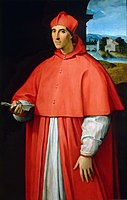

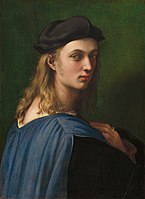

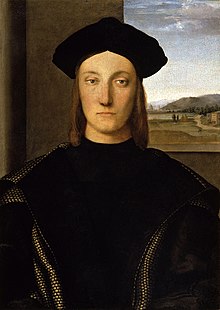
Drawings

Lucretia, engraved by Raimondi afterward a drawing by Raphael[71]
Raphael was ane of the finest draftsmen in the history of Western art, and used drawings extensively to programme his compositions. According to a almost-contemporary, when beginning to plan a composition, he would lay out a large number of stock drawings of his on the floor, and brainstorm to describe "apace", borrowing figures from here and there.[72] Over forty sketches survive for the Disputa in the Stanze, and there may well accept been many more originally; over 4 hundred sheets survive birthday.[73] He used different drawings to refine his poses and compositions, apparently to a greater extent than most other painters, to judge by the number of variants that survive: "... This is how Raphael himself, who was so rich in inventiveness, used to work, always coming up with four or vi ways to show a narrative, each one dissimilar from the residual, and all of them full of grace and well done." wrote some other writer after his death.[74] For John Shearman, Raphael'south fine art marks "a shift of resource away from production to enquiry and development".[75]
When a last composition was achieved, scaled-up full-size cartoons were frequently made, which were and then pricked with a pin and "pounced" with a bag of soot to exit dotted lines on the surface as a guide. He also made unusually extensive use, on both newspaper and plaster, of a "bullheaded stylus", scratching lines which go out only an indentation, but no mark. These can be seen on the wall in The Schoolhouse of Athens, and in the originals of many drawings.[76] The "Raphael Cartoons", equally tapestry designs, were fully coloured in a glue distemper medium, as they were sent to Brussels to exist followed past the weavers.
In later works painted by the workshop, the drawings are often painfully more attractive than the paintings.[77] Most Raphael drawings are rather precise—fifty-fifty initial sketches with naked outline figures are carefully drawn, and afterwards working drawings oft accept a high degree of stop, with shading and sometimes highlights in white. They lack the freedom and energy of some of Leonardo'southward and Michelangelo's sketches, only are almost e'er aesthetically very satisfying. He was one of the terminal artists to use metalpoint (literally a sharp pointed piece of silver or another metal) extensively, although he also fabricated superb use of the freer medium of ruby-red or black chalk.[78] In his final years he was one of the first artists to use female models for preparatory drawings—male person pupils ("garzoni") were normally used for studies of both sexes.[79]
-

Young Homo Carrying an Old Man on His Back, c. 1514
-
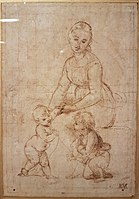
Written report for La Belle Jardinière
-

Nude Studies, 1515
-
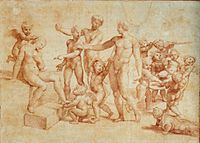
Wedlock of Alexander and Roxana. Study for Villa Farnesina
-

Developing the composition for a Madonna and Child
Printmaking
Raphael fabricated no prints himself, just entered into a collaboration with Marcantonio Raimondi to produce engravings to Raphael's designs, which created many of the most famous Italian prints of the century, and was important in the rise of the reproductive print. His interest was unusual in such a major artist; from his contemporaries it was but shared by Titian, who had worked much less successfully with Raimondi.[80] A total of most 50 prints were made; some were copies of Raphael'due south paintings, merely other designs were apparently created by Raphael purely to be turned into prints. Raphael made preparatory drawings, many of which survive, for Raimondi to translate into engraving.[81]
The almost famous original prints to effect from the collaboration were Lucretia, the Sentence of Paris and The Massacre of the Innocents (of which two virtually identical versions were engraved). Amid prints of the paintings The Parnassus (with considerable differences)[82] and Galatea were as well especially well known. Outside Italy, reproductive prints by Raimondi and others were the main way that Raphael's fine art was experienced until the twentieth century. Baviero Carocci, called "Il Baviera" by Vasari, an assistant who Raphael evidently trusted with his money,[83] concluded upwardly in command of virtually of the copper plates after Raphael'south expiry, and had a successful career in the new occupation of a publisher of prints.[84]
-

The Massacre of the Innocents, engraving past Marcantonio Raimondi from a design by Raphael.[e] Commencement state, "without fir tree"
Individual life and death

From 1517 until his death, Raphael lived in the Palazzo Caprini, lying at the corner between piazza Scossacavalli and via Alessandrina in the Borgo, in rather grand way in a palace designed by Bramante.[85] He never married, but in 1514 became engaged to Maria Bibbiena, Cardinal Medici Bibbiena's niece; he seems to have been talked into this past his friend the fundamental, and his lack of enthusiasm seems to be shown by the marriage not having taken place before she died in 1520.[86] He is said to take had many affairs, but a permanent fixture in his life in Rome was "La Fornarina", Margherita Luti, the daughter of a baker (fornaro) named Francesco Luti from Siena who lived at Via del Governo Vecchio.[87] He was made a "Groom of the Bedroom" of the Pope, which gave him status at court and an additional income, and also a knight of the Papal Club of the Golden Spur. Vasari claims that he had toyed with the ambition of becoming a cardinal, perhaps after some encouragement from Leo, which also may account for his delaying his marriage.[86]
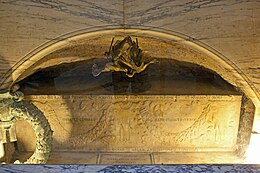
Raphael died on Adept Friday (Apr 6, 1520), which was maybe his 37th altogether.[f] Vasari says that Raphael had also been born on a Good Fri, which in 1483 fell on March 28,[chiliad] and that the artist died from exhaustion brought on past unceasing romantic interests while he was working on the Loggia.[89] Several other possibilities for his death take been raised by after historians and scientists,[h] such every bit a combination of an infectious disease and bloodletting.[90] In his acute illness, which lasted fifteen days, Raphael was equanimous enough to confess his sins, receive the last rites, and put his affairs in gild. He dictated his will, in which he left sufficient funds for his mistress's care, entrusted to his loyal servant Baviera, and left near of his studio contents to Giulio Romano and Penni. At his request, Raphael was buried in the Pantheon.[91]
Raphael'southward funeral was extremely thousand, attended by large crowds. According to a journal past Paris de Grassis,[i] four cardinals dressed in purple carried his body, the paw of which was kissed by the Pope.[92] The inscription in Raphael's marble sarcophagus, an elegiac distich written past Pietro Bembo, reads: "Here lies that famous Raphael by whom Nature feared to be conquered while he lived, and when he was dying, feared herself to die."[j]
- Self-portraits
-
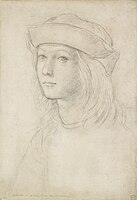
Likely cocky-portrait drawing by Raphael in his teens
-

Disquisitional reception

Raphael was highly admired by his contemporaries, although his influence on creative style in his ain century was less than that of Michelangelo. Mannerism, beginning at the time of his death, and later on the Baroque, took fine art "in a direction totally opposed" to Raphael's qualities;[93] "with Raphael's decease, classic art—the High Renaissance—subsided", as Walter Friedländer put it.[94] He was soon seen as the ideal model by those disliking the excesses of Mannerism:
the opinion ...was generally held in the middle of the sixteenth century that Raphael was the ideal balanced painter, universal in his talent, satisfying all the absolute standards, and obeying all the rules which were supposed to govern the arts, whereas Michelangelo was the eccentric genius, more than brilliant than any other artists in his item field, the cartoon of the male nude, but unbalanced and lacking in certain qualities, such as grace and restraint, essential to the great artist. Those, like Dolce and Aretino, who held this view were unremarkably the survivors of Renaissance Humanism, unable to follow Michelangelo as he moved on into Mannerism.[95]
Vasari himself, despite his hero remaining Michelangelo, came to run across his influence as harmful in some means, and added passages to the second edition of the Lives expressing similar views.[96]

Raphael's compositions were always admired and studied, and became the cornerstone of the preparation of the Academies of art. His period of greatest influence was from the late 17th to late 19th centuries, when his perfect decorum and balance were greatly admired. He was seen as the all-time model for the history painting, regarded as the highest in the hierarchy of genres. Sir Joshua Reynolds in his Discourses praised his "uncomplicated, grave, and majestic dignity" and said he "stands in full general foremost of the first [i.e., best] painters", especially for his frescoes (in which he included the "Raphael Cartoons"), whereas "Michael Angelo claims the next attention. He did not possess so many excellences as Raffaelle, only those he had were of the highest kind..." Echoing the sixteenth-century views above, Reynolds goes on to say of Raphael:
The excellency of this extraordinary man lay in the propriety, beauty, and majesty of his characters, his judicious contrivance of his limerick, correctness of drawing, purity of taste, and the skillful accommodation of other men's conceptions to his own purpose. Nobody excelled him in that judgment, with which he united to his ain observations on nature the energy of Michael Angelo, and the beauty and simplicity of the antiquarian. To the question, therefore, which ought to concord the first rank, Raffaelle or Michael Angelo, it must be answered, that if information technology is to be given to him who possessed a greater combination of the higher qualities of the art than whatever other human, there is no incertitude but Raffaelle is the showtime. But if, co-ordinate to Longinus, the sublime, being the highest excellence that human limerick can achieve to, abundantly compensates the absenteeism of every other beauty, and atones for all other deficiencies, then Michael Angelo demands the preference.[97]
Reynolds was less enthusiastic virtually Raphael'southward panel paintings, just the slight sentimentality of these made them enormously popular in the 19th century: "We accept been familiar with them from childhood onwards, through a far greater mass of reproductions than any other creative person in the earth has ever had..." wrote Wölfflin, who was born in 1862, of Raphael's Madonnas.[98]
In Germany, Raphael had an immense influence on religious fine art of the Nazarene movement and Düsseldorf school of painting in the 19th century. In contrast, in England the Pre-Raphaelite Brotherhood explicitly reacted confronting his influence (and that of his admirers such as Joshua Reynolds), seeking to return to styles that pre-dated what they saw as his noxious influence. According to a critic whose ideas greatly influenced them, John Ruskin:
The doom of the arts of Europe went along from that bedroom [the Stanza della Segnatura], and it was brought about in great role by the very excellencies of the man who had thus marked the commencement of decline. The perfection of execution and the beauty of characteristic which were attained in his works, and in those of his smashing contemporaries, rendered finish of execution and beauty of form the chief objects of all artists; and thenceforward execution was looked for rather than thought, and dazzler rather than veracity.
And as I told you, these are the ii secondary causes of the decline of art; the outset being the loss of moral purpose. Pray note them conspicuously. In mediæval art, thought is the first matter, execution the second; in modern art execution is the offset thing, and thought the second. And again, in mediæval art, truth is starting time, beauty 2d; in mod fine art, beauty is beginning, truth 2d. The mediæval principles led up to Raphael, and the modern principles lead downwardly from him.[99]
Past 1900, Raphael'southward popularity was surpassed by Michelangelo and Leonardo, perhaps as a reaction against the etiolated Raphaelism of 19th-century bookish artists such equally Bouguereau.[100] Although art historian Bernard Berenson in 1952 termed Raphael the "almost famous and nigh loved" chief of the Loftier Renaissance,[101] art historians Leopold and Helen Ettlinger say that Raphael's lesser popularity in the 20th century is made obvious by "the contents of art library shelves ... In contrast to book upon volume that reproduce all the same once more detailed photographs of the Sistine Ceiling or Leonardo's drawings, the literature on Raphael, particularly in English, is limited to only a few books".[100] They conclude, nonetheless, that "of all the slap-up Renaissance masters, Raphael'south influence is the almost continuous."[102]
Come across besides
- List of paintings by Raphael
- Domenico Alfani, a close friend of Raphael whose paintings have oft been mistaken for those of the better-known artist
Notes
Footnotes
- ^ Variants also include Raffaello Santi, Raffaello da Urbino, Rafael Sanzio da Urbino, or Raphael Sanzio. The surname Sanzio derives from the latinization of the Italian Santi into Santius. He normally signed documents as Raphael Urbinas – a latinized form. Gould:207
- ^ He is said to accept been born on Practiced Friday (March 28, 1483), only is stated to take been built-in on the aforementioned date equally his decease on the inscription of his tomb (he died iii hours subsequently the Ave Maria of Good Friday). Both birth dates cannot exist truthful.[3]
- ^ ,
- ^ After a visit to Verrocchio'southward workshop, Santi recorded that both Perugino and Leonardo da Vinci were present, and seems to have viewed them as being at an equivalent skill level. Later on Leonardo left for Milan, Santi chose Perugino from i of ii available artists to teach his son.[14]
- ^ The span in the groundwork is the Pons Fabricius.[56]
- ^ Raphael'due south age at expiry is debated by some, with Michiel asserting that Raphael died at 34, while Pandolfo Pico and Girolamo Lippomano arguing that he died at 33.[88]
- ^ Whereas Michiel said he died on his birthday. Art historian John Shearman addressed this apparent discrepancy: "The fourth dimension of death can exist calculated from the convention of counting from sundown, which Michaelis puts at half-dozen.36 on Fri 6 April, plus one-half-an-hour to Ave Maria, plus 3 hours, that is, soon after 10.00 pm. The coincidence noted between the nativity-date and death-engagement is usually thought in this case (since it refers to the Friday and Saturday in Holy Calendar week, the movable feast rather than the twenty-four hour period of the month) to fortify the argument that Raphael was likewise born on Good Friday, i.eastward., 28 March 1483. But in that location is a notable ambiguity in Michiel'due south note, not often noticed: Morse ... Venerdi Santo venendo il Sabato, giorno della sua Nativita, may likewise be taken to mean that his birthday was on Saturday, and in that case the awareness could besides exist the date, thus producing a birth-date of vii April 1483."[88]
- ^ Bufarale (1915) "diagnosed pneumonia or a war machine fever" while Portigliotti suggested pulmonary illness. Joannides stated that "Raphael died of over-work."[88]
- ^ Cited by Jean-G.-Vincent Audin, although there is some uncertainty as to the journal's existence.[92]
- ^ The original (in Latin): "Ille hic est Raffael, timuit quo sospite vinci, rerum magna parens et moriente mori".
Citations
- ^ Jones and Penny, p. 171. The portrait of Raphael is probably "a later accommodation of the one likeness which all agree on": that in The School of Athens, vouched for by Vasari.
- ^ Jones and Penny, p. ane and 246.
- ^ Salmi et al. 1969, pp. 585, 597.
- ^ On Neoplatonism, see Affiliate iv, "The Real and the Imaginary" Archived December 16, 2018, at the Wayback Machine, in Kleinbub, Christian Thou., Vision and the Visionary in Raphael, 2011, Penn Country Press, ISBN 978-0271037042
- ^ See, for example Honour, Hugh; Fleming, John (1982). A World History of Art. London: Macmillan Reference Books. p. 357. ISBN978-0333235836. OCLC 8828368.
- ^ Vasari, pp. 208, 230 and passim.
- ^ Osborne, June. Urbino: The Story of a Renaissance Urban center. p. 39 on the population, as a "few one thousand" at most; even today it is just 15,000 without the students of the University.
- ^ Jones and Penny, pp. ane–ii
- ^ Vasari:207 & passim
- ^ Jones & Penny:204
- ^ Vasari, at the get-go of the Life. Jones & Penny:5
- ^ Ashmolean Museum "Prototype". z.about.com. Archived from the original on December 2, 2007.
- ^ Jones and Penny: 4–v, 8 and twenty
- ^ Salmi et al. 1969, pp. xi–12.
- ^ Simone Fornari in 1549–50, run into Gould:207
- ^ Jones & Penny:8
- ^ contrasting him with Leonardo and Michelangelo in this respect. Wölfflin:73
- ^ Jones and Penny:17
- ^ Jones & Penny:ii–5
- ^ Ettlinger & Ettlinger:19
- ^ Ettlinger & Ettlinger:20
- ^ It was later on seriously damaged during an earthquake in 1789.
- ^ Jones and Penny:v–8
- ^ One surviving preparatory cartoon appears to be generally by Raphael; quotation from Vasari by – Jones and Penny:20
- ^ Ettlinger & Ettlinger:25–27
- ^ Gould:207–08
- ^ Jones and Penny:5
- ^ National Gallery, London Jones & Penny:44
- ^ Jones & Penny:21–45
- ^ Vasari, Michelangelo:251
- ^ Jones & Penny:44–47, and Wöllflin:79–82
- ^ "Image". szepmuveszeti.hu. Archived from the original on March 14, 2012.
- ^ Jones & Penny:49, differing somewhat from Gould:208 on the timing of his arrival
- ^ Vasari:247
- ^ Julius was no great reader—an inventory compiled afterward his death has a total of 220 books, large for the fourth dimension, but hardly requiring such a receptacle. In that location was no room for bookcases on the walls, which were in cases in the middle of the floor, destroyed in the 1527 Sack of Rome. Jones & Penny:4952
- ^ Jones & Penny:49
- ^ Graham-Dixon, Andrew (2008). Michelangelo and the Sistine Chapel. London: Weidenfeld & Nicolson. ISBN9781602393684 . Retrieved January 10, 2021.
- ^ Jones & Penny:49–128
- ^ Jones & Penny:101–05
- ^ Blunt:76, Jones & Penny:103–05
- ^ Book of the Courtier ane:26 The whole passage Archived December 24, 2007, at the Wayback Machine
- ^ Levey, Michael; Early Renaissance, p. 197 ,1967, Penguin
- ^ Jones & Penny:215–18
- ^ Jones & Penny:210–11
- ^ Jones & Penny:221–22
- ^ Jones & Penny:219–20
- ^ Jones and Penny:226–34; Raphael left a long alphabetic character describing his intentions to the Cardinal, reprinted in total on pp. 247–48
- ^ Jones & Penny:224–26 (quotation)
- ^ Salmi et al. 1969, pp. 572–73, 588.
- ^ Salmi et al. 1969, p. 110.
- ^ a b Jones & Penny:205 The letter may engagement from 1519, or before his date
- ^ Salmi et al. 1969, p. 582.
- ^ Salmi et al. 1969, pp. 569, 582.
- ^ Salmi et al. 1969, p. 570.
- ^ Salmi et al. 1969, p. 574.
- ^ a b Salmi et al. 1969, p. 579.
- ^ I, a portrait of Joanna of Aragon, Queen consort of Naples, for which Raphael sent an assistant to Naples to make a drawing, and probably left about of the painting to the workshop. Jones & Penny:163
- ^ Jones & Penny:133–47
- ^ Jones & Penny:192–97
- ^ Jones & Penny:235–46, though the relationship of Raphael to Mannerism, like the definition of Mannerism itself, is much debated. See Craig Hugh Smyth, Mannerism & Maniera, 1992, IRSA Vienna, ISBN three-900731-33-0
- ^ Roy, A., Leap, M., Plazzotta, C. 'Raphael'southward Early Work in the National Gallery: Paintings earlier Rome'. National Gallery Technical Bulletin Vol. 25, pp. four–35
- ^ Italian painters Archived March fifteen, 2016, at the Wayback Machine at ColourLex
- ^ Jones and Penny:146–47, 196–97; and Pon:82–85
- ^ Jones and Penny:147, 196
- ^ Vasari, Life of Polidoro online in English Archived April 17, 2008, at the Wayback Automobile Maturino for one is never heard of once more
- ^ Vasari:207 & 231
- ^ See for instance, the Raphael Cartoons
- ^ Jones & Penny:163–67 and passim
- ^ The direct transmission of grooming can be traced to some surprising figures, including Brian Eno, Tom Phillips and Frank Auerbach
- ^ Vasari (full text in Italian) pp. 197–98 & passim Archived Dec 24, 2007, at the Wayback Machine; see besides Getty Union Artist Proper name List Archived December eleven, 2007, at the Wayback Machine entries
- ^ "Lucretia". Metropolitan Museum of Art. Archived from the original on Apr 29, 2008. Retrieved Baronial 26, 2010.
- ^ Giovanni Battista Armenini (1533–1609) De vera precetti della pittura(1587), quoted Pon:115
- ^ Jones & Penny:58 & ff; 400 from Pon:114
- ^ Ludovico Dolce (1508–1568), from his L'Aretino of 1557, quoted Pon:114
- ^ quoted Pon:114, from lecture on The Organization of Raphael's Workshop, pub. Chicago, 1983
- ^ Not surprisingly, photographs practice not prove these well, if at all. Leonardo sometimes used a bullheaded stylus to outline his last choice from a tangle of different outlines in the same cartoon. Pon:106–110.
- ^ Lucy Whitaker, Martin Clayton, The Art of Italy in the Royal Collection; Renaissance and Baroque, p. 84, Royal Collection Publications, 2007, ISBN 978-one-902163-29-1
- ^ Pon:104
- ^ National Galleries of Scotland Archived May 31, 2012, at the Wayback Motorcar
- ^ Pon:102. Meet besides a lengthy analysis in: Landau:118 ff
- ^ The enigmatic human relationship is discussed at length by both Landau and Pon in her Chapters three and 4.
- ^ Pon:86–87 lists them
- ^ "Il Baviera" may mean "the Bavarian"; if he was German language, as many artists in Rome were, this would have been helpful during the 1527 Sack; Marcantonio had many printing-plates looted from him. Jones and Penny:82, see too Vasari
- ^ Pon:95–136 & passim; Landau:118–60, and passim
- ^ Gigli (1992), p. 46
- ^ a b Vasari:230–31
- ^ Art historians and doctors debate whether the right hand on the left breast in La Fornarina reveal a cancerous breast tumour detailed and disguised in a classic pose of love. "The Portrait of Chest Cancer and Raphael's La Fornarina", The Lancet, December 21–28, 2002.
- ^ a b c Shearman: 573.
- ^ Salmi et al. 1969, p. 598.
- ^ Riva, Michele Augusto; Paladino, Maria Emilia; Motta, Marco; Belingheri, Michael (January one, 2021). "The death of Raphael: a reflection on bloodletting in the Renaissance". Internal and Emergency Medicine. 16 (1): 243–244. doi:x.1007/s11739-020-02435-8. ISSN 1970-9366. PMID 32666175. S2CID 220528453.
- ^ Vasari:231
- ^ a b Salmi et al. 1969, pp. 598–99.
- ^ Chastel André, Italian Fine art, p. 230, 1963, Faber
- ^ Walter Friedländer, Mannerism and Anti-Mannerism in Italian Painting, p. 42 (Schocken 1970 edn.), 1957, Columbia UP
- ^ Edgeless:76
- ^ See Jones & Penny:102–04
- ^ The 1772 Soapbox Online text of Reynold's Discourses Archived 2007-02-27 at the Wayback Automobile The whole passage is worth reading.
- ^ Wölfflin:82,
- ^ John Ruskin (1853), Pre-Raphaelitism, p. 127 online at Project Gutenburg Archived 2008-12-26 at the Wayback Machine
- ^ a b Ettlinger & Ettlinger:11
- ^ Berenson, Bernard, Italian Painters of the renaissance, Vol ii Florentine and Central Italian Schools, Phaidon 1952 (refs to 1968 ed), p. 94
- ^ Ettlinger & Ettlinger:230
References
- Blunt, Anthony, Creative Theory in Italia, 1450–1660, 1940 (refs to 1985 edn), OUP, ISBN 0-19-881050-4
- Gould, Cecil, The Sixteenth Century Italian Schools, National Gallery Catalogues, London 1975, ISBN 0-947645-22-5
- Ettlinger, Leopold D., and Helen South. Ettlinger, Raphael, Oxford: Phaidon, 1987, ISBN 0714823031
- Roger Jones and Nicholas Penny, Raphael, Yale, 1983, ISBN 0-300-03061-4
- Landau, David in:David Landau & Peter Parshall, The Renaissance Impress, Yale, 1996, ISBN 0-300-06883-ii
- Pon, Lisa, Raphael, Dürer, and Marcantonio Raimondi, Copying and the Italian Renaissance Print, 2004, Yale Upwards, ISBN 978-0-300-09680-4
- Salmi, Mario; Becherucci, Luisa; Marabottini, Alessandro; Tempesti, Anna Forlani; Marchini, Giuseppe; Becatti, Giovanni; Castagnoli, Ferdinando; Golzio, Vincenzo (1969). The Complete Work of Raphael. New York: Reynal and Co., William Morrow and Company.
- Shearman, John; Raphael in Early Modern Sources 1483–1602, 2003, Yale University Press, ISBN 0-300-09918-5
- Vasari, Life of Raphael from the Lives of the Artists, edition used: Artists of the Renaissance selected & ed Malcolm Bull, Penguin 1965 (page nos from BCA edn, 1979)
- Wölfflin, Heinrich; Classic Art; An Introduction to the Renaissance, 1952 in English (1968 edition), Phaidon, New York.
- Gigli, Laura (1992). Guide rionali di Roma (in Italian). Vol. Borgo (II). Roma: Fratelli Palombi Editori. ISSN 0393-2710.
Further reading
- The standard source of biographical information is now: V. Golzio, Raffaello nei documenti nelle testimonianze dei contemporanei eastward nella letturatura del suo secolo, Vatican City and Westmead, 1971
- The Cambridge Companion to Raphael, Marcia B. Hall, Cambridge University Press, 2005, ISBN 0-521-80809-X,
- New catalogue raisonné in several volumes, still being published, Jürg Meyer zur Capellen, Stefan B. Polter, Arcos, 2001–2008
- Raphael. James H. Beck, Harry N. Abrams, 1976. LCCN 73-12198, ISBN 0-8109-0432-2
- Raphael, Pier Luigi De Vecchi, Abbeville Printing, 2003. ISBN 0789207702
- Raphael, Bette Talvacchia, Phaidon Press, 2007. ISBN 9780714847863
- Raphael, John Pope-Hennessy, New York Academy Printing, 1970, ISBN 0-8147-0476-X
- Raphael: From Urbino to Rome; Hugo Chapman, Tom Henry, Carol Plazzotta, Arnold Nesselrath, Nicholas Penny, National Gallery Publications Express, 2004, ISBN 1-85709-999-0 (exhibition catalogue)
- The Raphael Trail: The Secret History of Ane of the World'southward Most Precious Works of Art; Joanna Pitman, 2006. ISBN 0091901715
- Raphael: A Critical Catalogue of his Pictures, Wall-Paintings and Tapestries, catalogue raisonné by Luitpold Dussler published in the Usa past Phaidon Publishers, Inc., 1971, ISBN 0-7148-1469-5 (out of print, but an online version is here [1])
- Raphael at the Metropolitan: The Colonna Altarpiece, Wolk-Simon, Linda. (2006). New York: The Metropolitan Museum of Fine art. ISBN 978-1588391889.
- Raphael and the Antique, Claudia La Malfa, Reaktion Books, 2020. ISBN 9781789141504
External links
 | Wikiquote has quotations related to: Raphael |
- 120 artworks by or after Raphael at the Art UK site
- Raphael Enquiry Resources from the National Gallery, London
- V&A London online feature on the Raphael Cartoons
- 10 drawings and iii paintings from the Imperial Drove
- Web Gallery of Art
- Most of the Raphael/Raimondi prints from the San Francisco Museums
- Raphael Project/Raffael Projekt
- Website of Teylers Museum on the provenance of the Raphael drawings in the museum's collection.
- Birthplace Museum of Raphael, Urbino, on the Artist's Studio Museum Network website
- Mobilier national (France) drove of tapestries
- Raphael Santi at ColourLex.
- Raphael at the National Gallery of Art
- Guide to the Raphael Spurious Letters undated at the University of Chicago Special Collections Research Centre
hendersonshat1988.blogspot.com
Source: https://en.wikipedia.org/wiki/Raphael

Post a Comment for "What Style of Art Was Oil Painting in the 1500s"